What Affects the Value of a 1979 Penny Today
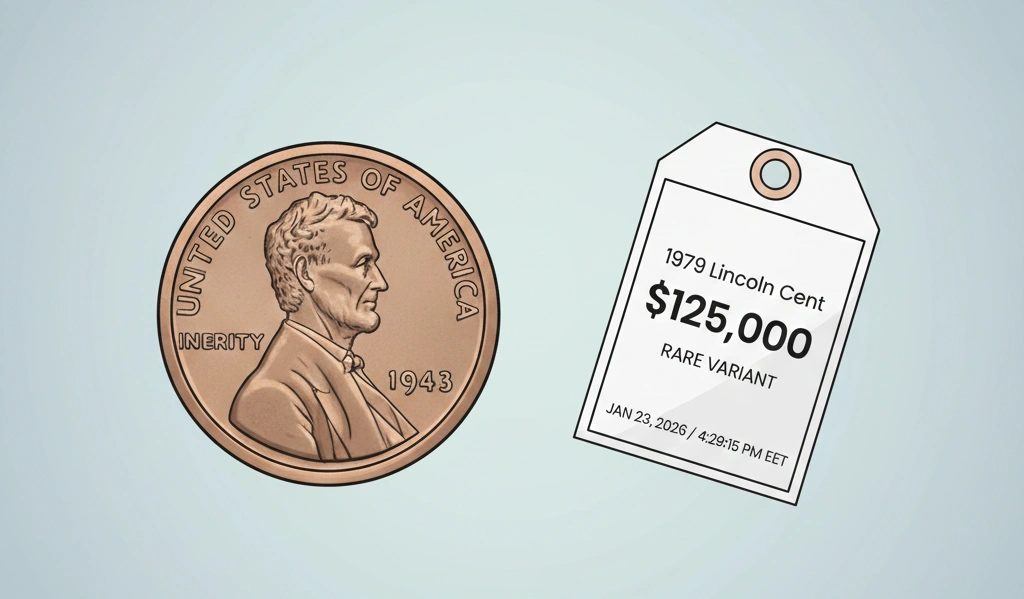
The 1979 penny value depends on a combination of technical characteristics and market demand for specific specimens.
The main evaluation criteria include the minting location, the physical preservation of the surface, and the presence of manufacturing defects.
Coins of this year consist of an alloy including 95% copper and 5% zinc.
The total mintage exceeded 10 billion specimens, being distributed among three main facilities.
Characteristic | Value |
Weight | 3.11 grams |
Diameter | 19.05 mm |
Composition | 95% Cu, 5% Zn |
Obverse Designer | Victor David Brenner |
Reverse Designer | Frank Gasparro |
In 1979, minting was carried out by the mints in Philadelphia, Denver, and San Francisco.
Coins from Philadelphia do not have a mint mark on the obverse.
The Philadelphia mintage amounted to 6,018,515,000 pieces.
The mass production makes common specimens from circulation equivalent to their face value or the value of the metal contained within.
The Denver Mint marked its products with the letter "D," producing 4,139,357,254 coins.
Statistically, specimens bearing the "D" mark appear in circulation less frequently than Philadelphia ones, maintaining a minimal collector premium in average condition.
San Francisco produced Proof quality coins intended for collector sets, marked with the letter "S."
The mintage of the Proof category amounted to 3,677,175 specimens.
State Classification and Price Ranges
Numismatic value directly depends on the Sheldon scale, grading coins from 1 to 70 points.
Coins in MS (Mint State) condition demonstrate significant price growth when moving from one numerical value to another.
Condition | Average Market Price (USD) |
Circulated | $0.02 – $0.05 |
MS 63 (Uncirculated) | $0.10 – $0.25 |
MS 65 (Gem BU) | $1.00 – $5.00 |
MS 67 (Superb Gem) | $20.00 – $150.00 |
MS 68+ (Top Pop) | $1,000+ |
Value Change Based on Grading
Statistical data from auction houses over recent decades confirm a non-linear dependence of price on condition.
The price of a coin in MS 67 condition can exceed the cost of an MS 65 specimen by 30–50 times.
The annual value increase for rare specimens of the highest preservation is approximately 3–5%, considering inflationary processes and the decreasing number of available lots.
For ordinary coins from circulation, the price remains stagnant, being tied to the cost of copper.
Record Sales of the 1979 Penny
Auction records capture the maximum amounts paid for specimens with unique characteristics.
In 2012, at Heritage Auctions, a 1979 coin without a mint mark (Philadelphia) in MS 68 Red condition was sold for $1,265.
A 1979-D specimen in MS 68 Red condition recorded a price maximum of $3,995 in 2023.
Proof category coins also demonstrate high value when possessing deep contrast (Deep Cameo).
The record for a 1979-S Type 2 in PR 70 Deep Cameo condition exceeds $10,000, being driven by the rarity of perfect die preservation.
San Francisco Mint Varieties (Type 1 and Type 2)
In 1979, a replacement of the working die applying the "S" letter to Proof quality coins occurred.
This led to the emergence of two clearly distinguishable types of the mint mark.
Type 1 (Sfilled) is characterized by a fuzzy, blob-like image of the letter "S," having internal loops that are virtually invisible.
Type 2 (Clear S) possesses clear boundaries and a pronounced relief of the letter.
The market value of Type 2 is consistently higher due to the smaller production volume at the end of the year.
Type 2 specimens in PR 69 condition trade in the $15–$30 range, while Type 1 costs about $5–$10.
Errors and Their Impact on Price
Defective specimens passing through quality control represent the greatest interest for market researchers and can be checked with the coin value app.
Minting errors are classified by types having different degrees of rarity.
Double Die: Displacement of the image on the obverse or reverse. The 1979 issue lacks major, widely recognized errors of this type comparable to 1955 or 1972, yet minor doublings cost between $10 and $50.
Off-Center Strike: Minting of a coin produced with incomplete placement of the planchet in the die area. A coin with a 10% displacement is valued at $5–$15, while a 50% displacement retaining the date increases the price to $100–$250.
Wrong Planchet: Extremely rare cases of a 10-cent planchet entering the penny machine. The value of such specimens starts at $500 and can reach several thousand depending on preservation.
Die Crack: Raised lines on the surface resulting from damage to the printing form. The price varies from $2 to $20.
Coin Color as a Pricing Factor
Numismatists classify copper coins into three color categories affecting the final evaluation.
The RD (Red) category is assigned to coins retaining more than 95% of the original copper luster.
The RB (Red-Brown) category signifies the presence of 5–95% of the reddish tint.
The BN (Brown) category indicates full surface oxidation lacking the original luster.
Specimens in RD condition are valued significantly higher than others, since copper tarnishes quickly when contacting oxygen.
Losing the original color reduces the value of an MS 65 coin by 40–60%.
Market Dynamics and Forecasts
Analysis of trading platforms shows a stable presence of the 1979 penny in low and medium-priced segments.
Investment attractiveness is preserved only for specimens with a grade of MS 67 and higher.
The value growth of such coins correlates with the general index of rare US coin prices, demonstrating stability during periods of economic volatility.
Decreasing supply of top-quality coins at open auctions stimulates price increases during major auction events.
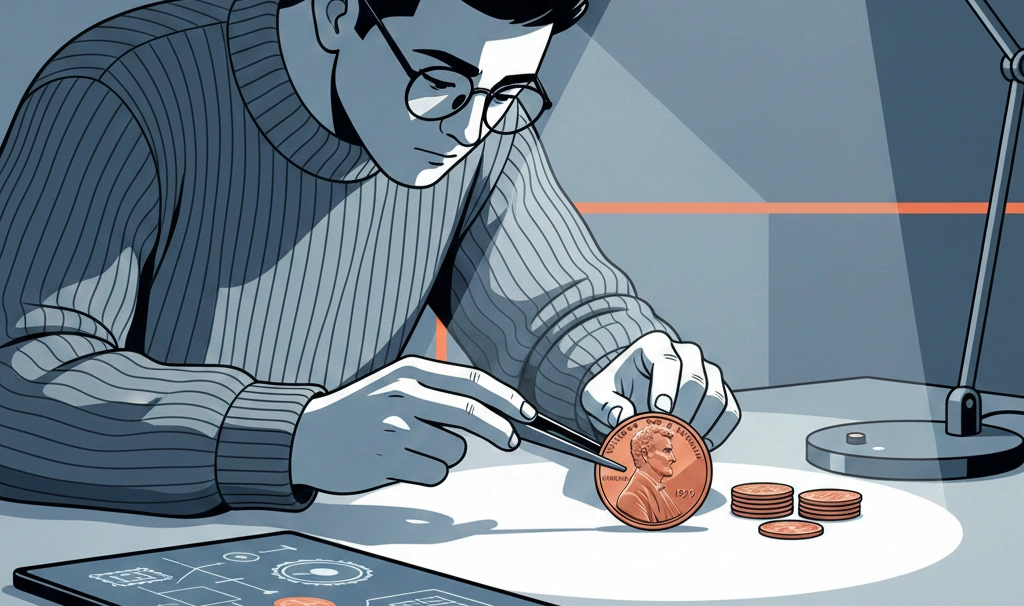
To determine the potential value of a 1979 coin, a sequential inspection must be performed.
Initially, the presence of the mint mark under the date should be checked.
The absence of a mark or the letter "D" requires evaluating luster and the absence of scratches using a ten-fold magnifying glass.
Discovering a coin with the letter "S" implies identifying the mark type (Type 1 or Type 2) for accurate catalog positioning.
The presence of any deviations in image geometry or planchet shape serves as a reason for expert evaluation.
Conclusion
The 1979 penny represents a mass numismatic object, having a value varying from face value to several thousand dollars.
The decisive factor remains the physical condition, being confirmed by a certificate from an independent grading company like the free coin identifier app, NGC, or PCGS.
Investing in these coins requires a deep understanding of color grading and auction sales specifics.